
Airport Security Is Bigger Than the TSA Checkpoint
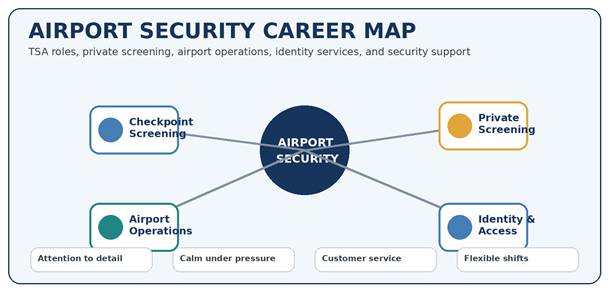
Airport security careers extend far beyond Transportation Security Officers. Airports rely on federal screeners, private screening contractors, airline security teams, airport operations staff, identity-verification companies, access-control specialists, baggage and cargo security teams, and technology vendors. For job seekers, this creates several entry points into aviation security without requiring the same employer, uniform, or career path.
The sector is changing in 2026. Private-screening partnerships are receiving more attention, while biometric identity and automated checkpoint technology continue expanding at major airports. These changes are creating a broader mix of customer-facing, operational, technical, and supervisory roles.
1. Transportation Security Officer and Checkpoint Roles
Transportation Security Officers screen passengers and baggage, manage checkpoint procedures, respond to alarms, and work within strict security rules. The job suits applicants who handle repetition well, communicate clearly, remain calm with the public, and accept early-morning, overnight, weekend, or holiday shifts.
Applicants who want a direct look at a current opening can review this Airport Security Jobs listing and compare the schedule, location, responsibilities, and hiring requirements with their availability.
2. Private Airport Screening Contractors
Some U.S. airports use private screening companies under federal oversight. These screeners perform passenger and baggage screening functions similar to TSA checkpoint work, but the employer is a private contractor. Compensation, benefits, scheduling rules, seniority systems, and advancement structures depend on the contractor and airport agreement.
Private screening can appeal to applicants who want airport security experience while working for a commercial employer. The tradeoff is that employment terms may change when contracts change, so candidates should examine the employer, benefit package, contract history, and transfer options before accepting a role.
3. Airport Operations and Access Control
Airports employ or contract personnel to manage secure-area access, credential checks, vehicle gates, perimeter patrol, incident reporting, badging offices, and operational coordination. These roles often combine security awareness with customer service and administrative accuracy. Some positions are entry-level, while others require prior airport, military, security, or law-enforcement experience.
4. Identity Verification and Passenger Services
Private identity companies now play a larger role around airport checkpoints. Employees may verify identity, assist travelers with enrollment, explain membership services, operate biometric systems, or support access workflows. CLEAR reports operating across dozens of major U.S. airports, showing how private identity and access roles have become part of the modern checkpoint environment.
5. Airport and Airline Security Support
Airlines, cargo operators, airport authorities, and service vendors also recruit security coordinators, baggage-security staff, cargo-screening personnel, dispatchers, surveillance operators, and safety specialists. These jobs may sit outside TSA while still supporting the same goal: protecting passengers, aircraft, facilities, and restricted areas.
How the Career Paths Compare
|
Path |
Employer |
Typical Focus |
Good Fit For |
|
TSA checkpoint |
Federal agency |
Passenger and baggage screening |
Applicants seeking structured federal service |
|
Private screening |
Contractor |
Checkpoint screening under federal standards |
Applicants open to commercial employment |
|
Airport operations |
Airport authority/vendor |
Access, patrol, badging, coordination |
Applicants who prefer broader airport duties |
|
Identity services |
Private technology company |
Biometrics, enrollment, traveler assistance |
Customer-service and tech-oriented applicants |
|
Airline/cargo security |
Airline or logistics employer |
Aircraft, cargo, facility security |
Applicants interested in operations and logistics |
Skills That Transfer Across These Jobs
- Attention to detail and consistent rule-following
- Calm communication with travelers and coworkers
- Comfort standing or walking for long periods
- Reliable attendance and flexible scheduling
- Accurate documentation and incident reporting
- Ability to learn security technology and procedures
How to Search More Broadly
Do not search only one job title. Try combinations such as airport security, checkpoint screener, aviation security, access control, badging specialist, security coordinator, passenger services, cargo security, airport operations, and identity verification. Broader searches surface employers that operate inside airports but are not part of TSA.
You can also browse broader TSA Jobs and compare airport-related listings by employer, location, work schedule, and required experience instead of treating every aviation-security role as the same job.
External Career Reference
For a current example of a private aviation-security employer, see Clear Careers. Its airport and arena roles show how identity, customer service, and security technology fit alongside traditional checkpoint work.
Frequently Asked Questions
Are all airport security workers TSA employees?
No. Airports also use private contractors, airport authority staff, airline security teams, cargo-security workers, and identity-service companies.
Do private screeners follow the same security standards?
Private checkpoint screeners operate under federal security requirements, but their employer, benefits, and internal policies differ from federal TSA employment.
Do airport security jobs require a college degree?
Many entry-level screening and operations roles do not require a four-year degree. Specialized intelligence, management, cybersecurity, or technical roles may require additional education or experience.
What schedules are common?
Airports operate early mornings, late nights, weekends, and holidays. Flexible availability improves access to many entry-level roles.
Which path offers the best long-term growth?
It depends on your goal. Federal service offers one structure, while airports and private companies may provide faster movement into operations, leadership, customer experience, or technology roles.
Final Takeaway
Airport security is an ecosystem, not a single job. Start with the type of work you want to perform, then compare employer, schedule, benefits, training, advancement, and security responsibilities. A wider search gives you more ways to enter aviation and build experience that transfers across the airport environment.
About the Author
